
Photo by Robert Martin: particpants in the DELTA at 5 conference 2025
Jane reflects on Result’s biggest programme re-starting and on her own experience of disability rights.
On this day 19 years ago, the UN’s Convention on the Rights of Persons with Disabilities (UNCRDP) was signed by 82 countries; the highest number on an opening day in the UN’s history. The convention draws on international human rights law to‘promote, protect and ensure the full enjoyment of all human rights and fundamental freedoms by all persons with disabilities’. 3rd December is both an awareness day – a reminder of the contribution disabled people make to our societies – but also a day for celebration. What better way could disabled-led Result find to celebrate than to work directly with a brilliant cohort of disabled leaders?
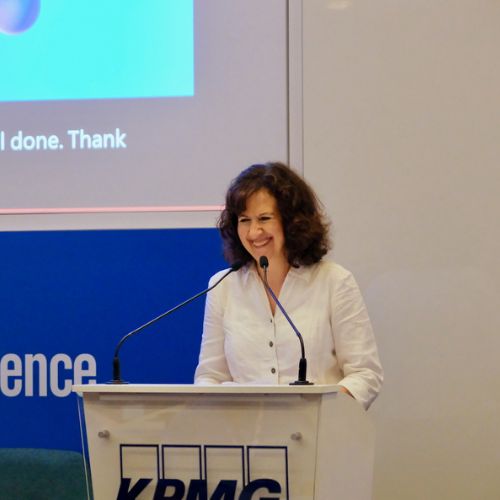 Jane Cordell at the Delta at 5 conference, 2025. Photo by Robert Martin.
Now in its sixth remarkable year, DELTA (Disability Empowers Leadership Talent) sees over 100 civil servants - who have won a place on the Civil Service’s elite ‘Future Leadership Scheme’ - come together from across the country and from within the Government to participate in the programme which Result has delivered since 2019.
Yesterday in London, with a 12-strong team of coaches, eight of whom are also workshop facilitators, all of whom are disabled, neurodiverse or live with a long-term health condition, Result excitedly embarked on the opening workshop, ‘Your identity, experience and strengths’ with the first of five groups. The participants are all civil servants in the grades just beneath the Senior Civil Service (SCS). Four workshops over seven months are complemented by four one-to-one coaching sessions. It is a real privilege for Result to facilitate this programme that was masterminded by the brilliant Charlotte Hart who deservedly won a Civil Service-wide award for her work on this, earlier this year.
Why is it important for disabled leaders to have dedicated additional support? Perhaps the easiest way to answer that question is to quote a couple of our participants. One said of their experience, ‘Without a shadow of a doubt, this is the most valuable programme I've been on in 21 years.’ Another said, ‘I cannot undersell the importance of this programme to my own personal and professional development.’ When we meet the leaders, there is a consistently strong theme that runs through their experiences – that of needing greater confidence in being who they are as well as making the shift so to be more able to integrate their disability into their leadership practice.
How far have we come? In 2006 the UNCRDP marked a vital milestone in recognising the specific rights of disabled people. In almost two decades since, there have been breakthroughs and, sadly, a lot of backsliding. I hear repeatedly from disabled contacts that they feel disability is always at the ‘back of the queue’ compared to some other minority characteristics. This state of affairs has always puzzled me. Countries that want to thrive need their citizens to contribute all their skills. It simply doesn’t make economic or moral sense to adopt policies which exclude a third of them.
On 3 December 2006, I had been in my first diplomatic overseas posting for 10 months. I was a guinea pig: the first profoundly deaf diplomat at my level to undertake such a posting. To describe it as a rollercoaster ride would be an understatement. Happily, I benefited from most of my colleagues being open-minded and supportive. Crucially, though, I had the right ‘adjustments’ in the form of human support – lipspeakers who alternated short periods working with me in Poland. Encouraged by my Ambassador, I undertook additional work on top of the day job, to promote connections with the Polish Government and leading NGOs (non-Governmental organisations) concerning disability rights. Over the 4 years of the posting, and using the Polish language which the Foreign Office had invested in me learning, this work was highly successful.
I have one particularly striking memory. Shortly before I left Poland, I was invited to the Polish Sejm (parliament) to witness the first day of the newly designed accessible main hall and 4 wheelchair-user MPs gliding to the speaker’s podium for the first time ever to rapturous applause. Previously, the building’s design meant this could not happen. It was a truly powerful moment – and a symbol of what could be achieved if a positive approach was taken to access.
So, to be told shortly afterwards that the key posting I had already been offered on merit was being questioned due to the cost of the adjustments I required was, of course, devastating at a personal level. But it was more than that. It was a denial of the positive example the UK had shown to Poland – then a newcomer to the EU –and many other countries via its adoption of the social model of disability as well as setting up schemes such as Access to Work.
It's worth mentioning a quirk of my unusual career: I never expected to even be in the diplomatic service. I only applied because in the role I held before, as an editor, I experienced terrible disability discrimination from the boss. So, I needed to escape. It’s interesting (and so often frustrating), when you are a disabled professional, how to what extent the vagaries of each organisation, and particularly its individual senior leaders, can affect – sometimes profoundly - your career trajectory.
Result winning the tender to run DELTA felt like coming full circle for me. To be able to draw positively on the acutely painful and sustained experience of discrimination in government while being offered the opportunity to support a large group of influential policy-makers and leaders, was a dream come true. My gratitude for this opportunity is limitless; as must my – and Result’s – commitment be to raising awareness of how much progress we still have to make.
Happy International Day of Persons with Disabilities!